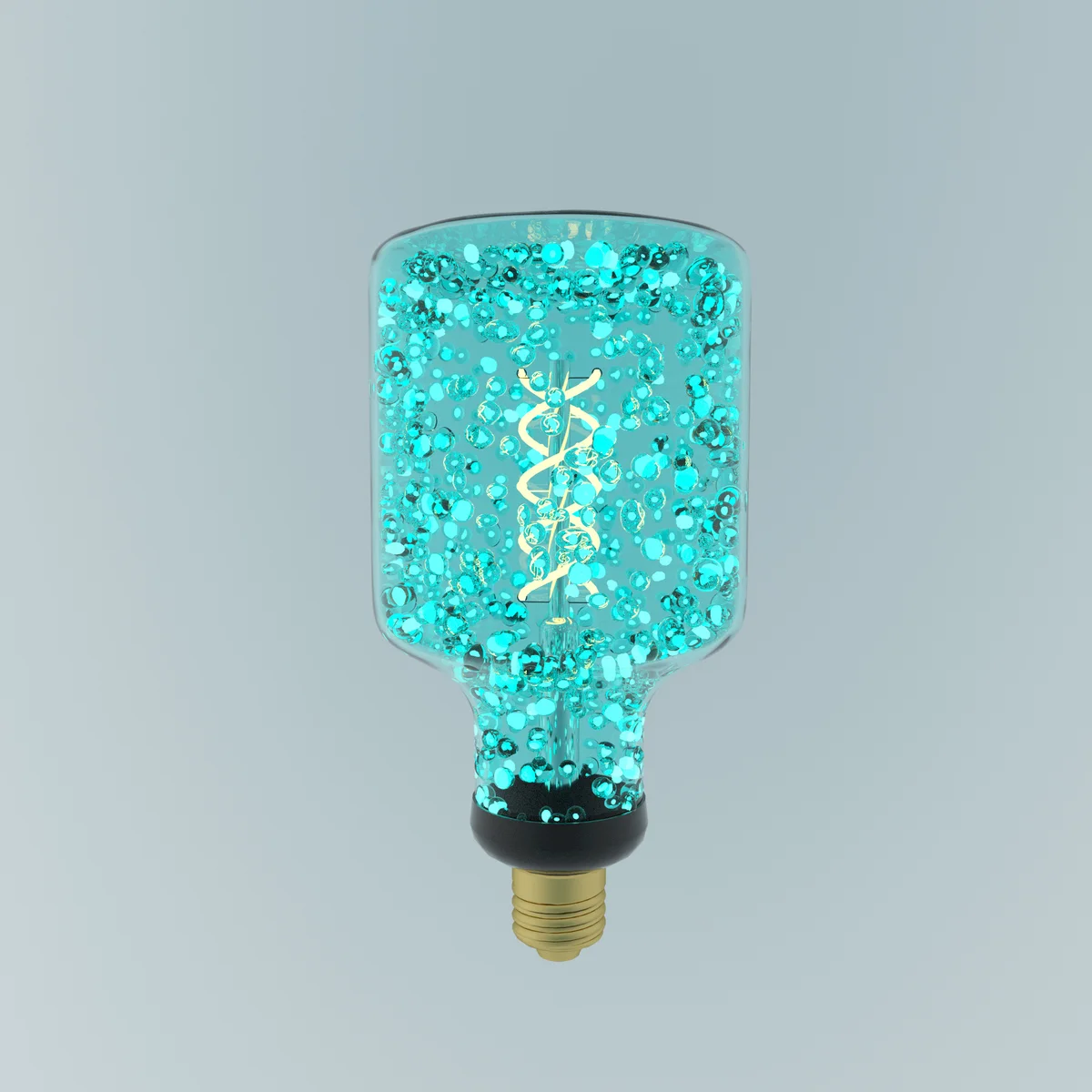
This is a newly developed glow-in-the-dark vintage bulb. Its design is based on luminous glass — glass infused with phosphorescent stone particles. These luminous stones have a remarkable ability: they absorb light, store energy, and then emit light in the dark.
The luminous stones can emit light in several colors at night:
The principle is straightforward: during the day or when the bulb is on, the luminous stones absorb and store light energy. In darkness, they continuously release this stored energy as visible light. It's important to note that the phosphorescent stones are merely a medium for transferring light energy — they cannot create light on their own.
Luminous stone, also known as phosphorescent stone, is primarily composed of strontium aluminate and zinc sulfide. These are synthetically produced materials with no radioactivity whatsoever. They glow purely by storing and releasing light energy, making them completely safe for everyday use.
When we first saw luminous glass glowing at night, we were captivated by its beauty. The idea struck us immediately: if we could make this into a light bulb, it would be even more stunning. A vintage bulb is already a light source — the luminous stones would absorb energy while the bulb is on, and after turning it off, every particle would glow like a star in the night sky. Like an endless cosmos right in your room.
The initial glow is remarkably strong — bright enough to see objects within a 1-meter radius. Over time, the brightness gradually fades: approximately 30% light decay after 1 hour, about 50% after 2 hours. If fully charged, the luminous stones will continue glowing for roughly 4 hours, retaining about 20% brightness at the end.
When we first had this idea, we visited a glass factory. The factory owner and engineers were enthusiastic and worked hard to help us solve the technical challenges. We experimented with many different sizes of luminous stones and various glass thicknesses to find the optimal combination.
The core challenge was balance: if the luminous stones are too large (say 4mm diameter), the glass must be at least 6mm thick to fully encapsulate them. This produces beautiful, strong glow effects, but the glass becomes too heavy to make into a practical bulb. On the other hand, if the stones are too small (around 2mm), the glass can be thinner and lighter, but the glow effect becomes less impressive.
After extensive prototyping and comparison, we found the sweet spot — the ideal luminous stone size and glass thickness. The stones are mixed into molten glass, stirred evenly, and the resulting luminous glass is then shaped into vintage bulb shells.
The finished luminous stone vintage bulb is truly magical at night. After turning off the lights, every phosphorescent particle in the glass glows, creating an effect like lying in bed and gazing at a sky full of stars. The experience is extraordinary, especially when multiple bulbs are used together — it feels like floating in space, surrounded by an infinite cosmos.
No. The luminous stones are made of strontium aluminate and zinc sulfide — synthetic materials with zero radioactivity. They glow by storing and releasing light energy only.
After a full charge, the glow lasts approximately 4 hours. Initial brightness is strong enough to see objects within 1 meter. After 1 hour, brightness decreases by about 30%; after 2 hours, about 50%.
Yellow-green (brightest, longest lasting), blue-green (cool tone), and sky blue (good visual effect with slightly higher CRI).
Yes! That's one of the most popular use cases. The gradual dimming effect is actually perfect for falling asleep.